ISOBUS-Certified QYX Pro: Smarter Precision Farming

What ISOBUS certification means for QYX Pro users
ISOBUS certification proves that QYX Pro can communicate reliably with ISOBUS-compatible tractors and implements from multiple brands, using the ISO 11783 standard. For users, this means one terminal, plug‑and‑play connections, and confidence that guidance, task data, and implement control will work together in the same workflow.
Before ISOBUS, many cabs were full of brand‑specific displays, each speaking its own “language.” Farmers had to learn different interfaces and wiring schemes, and switching implements often meant re‑configuring hardware. ISOBUS changes that by defining a universal communication protocol between tractor, implement, and terminal, overseen by the Agricultural Industry Electronics Foundation (AEF). An ISOBUS‑certified terminal behaves like a universal hub rather than a locked‑in screen.
In practice, when an ISOBUS implement is plugged into an ISOBUS tractor, the implement uploads its interface to the terminal, which renders the right buttons and status information automatically.
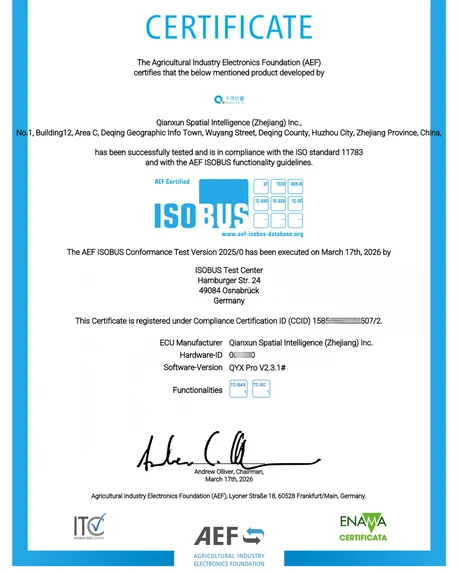
QYX Pro’s second ISOBUS certificate is more than a badge. It is a formal, independently verified guarantee that the terminal’s key functions conform to ISO 11783, and that they interoperate with major tractor ECUs and implement controllers in real‑world scenarios. For Spatix partners building guidance, auto‑steering, or implement‑control solutions on top of QYX Pro, this drastically reduces integration risk and speeds up go‑to‑market.
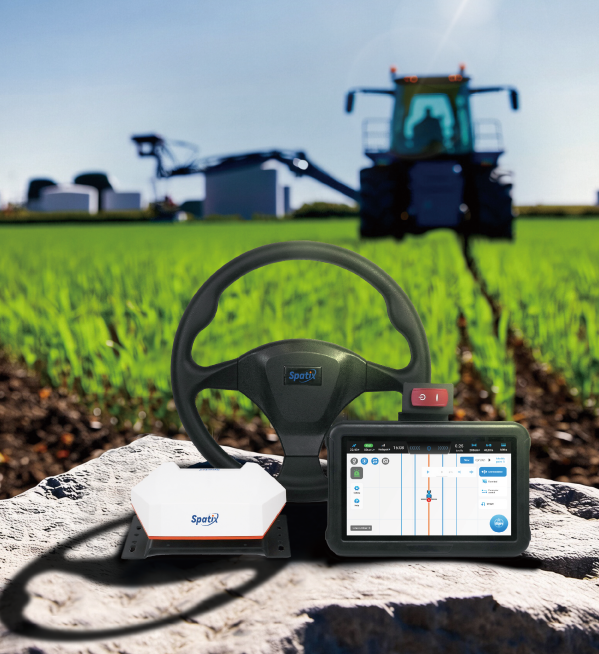
How TC-BAS and TC-SC turn QYX Pro into a field efficiency engine
TC‑BAS (Task Controller – Basic) and TC‑SC (Task Controller – Section Control) are two of the most valuable ISOBUS task controller functions for precision agriculture. TC‑BAS logs task totals such as worked area and applied product, while TC‑SC uses GNSS position to switch boom or section groups on and off automatically to avoid overlaps and gaps.
With QYX Pro now certified for TC‑BAS and TC‑SC, Spatix partners can expose these capabilities directly in their solutions without custom, brand‑specific integrations. For example, a partner building a spreading solution can rely on QYX Pro to log total hectares, tons per field, and machine hours automatically via TC‑BAS, while TC‑SC handles all section switching on a 36‑meter boom.
The impact is concrete. Studies and vendor case reports consistently show section control saving 5–15% in inputs depending on field shape and operation type. On a 1,000‑hectare farm applying nitrogen at $150 per hectare, even a 7% savings from TC‑SC translates into more than $10,000 retained per season. Because QYX Pro provides this as a standard, certified function, partners can build “efficiency in a box” offerings that deliver measurable ROI from day one.
Partner and farmer benefits: interoperability, savings, and scalability
For both OEM partners and end users, interoperability is often the biggest pain point. Mixed fleets of John Deere, New Holland, and regional tractor brands combine with implements from different manufacturers, each with its own control box. This fragmentation slows deployments and inflates support costs.
By aligning QYX Pro with the ISOBUS standard and earning certification, Spatix removes much of this friction. Partners can position QYX Pro as a single, high‑precision GNSS terminal that “speaks ISOBUS” out of the box, reducing the need for proprietary harnesses and displays. Farmers gain the freedom to buy the best implement for the job, knowing that if it carries the ISOBUS and AEF marks, it can work with their existing QYX Pro‑based system.
The savings go beyond hardware. When a terminal doubles as both guidance display and ISOBUS Virtual Terminal, operators only learn one interface. Training times drop sharply compared with setups that require separate GNSS screens, implement controllers, and application monitors, as highlighted by ISOBUS solution providers focused on simplifying VT‑based control.
Finally, certification makes solutions more scalable. A partner can validate its solution with a single reference fleet and then roll the same architecture to dozens of customers. Because QYX Pro behaves predictably with other certified components on the ISOBUS network, each new installation is closer to “configure and go” than “start an R&D project.”
Real-world use cases: from mixed fleets to input optimization
The value of QYX Pro’s ISOBUS capabilities becomes most visible in real operating scenarios. Consider a contractor with a mixed fleet: a European tractor working alongside a locally branded model, plus seeders, sprayers, and spreaders from three different manufacturers. Historically, that cab might contain three or four separate displays and wiring looms.
With QYX Pro as the ISOBUS terminal, the contractor can consolidate control into a single screen. Connect an ISOBUS seeder, and the implement’s interface appears on QYX Pro’s display. Switch to a sprayer, and TC‑SC automatically manages section switching, ensuring no overlap at the field boundary. The same GNSS corrections that drive QYX Pro’s guidance functions also feed the ISOBUS task controller, so position‑based automation stays consistent across machines.
For Spatix partners, these scenarios translate into concrete solution blueprints: “mixed‑fleet consolidation kit,” “input‑efficiency spraying package,” or “compliance‑ready documentation stack,” all built around QYX Pro’s certified ISOBUS functions.
How QYX Pro was tested: reliability behind the certificate
ISOBUS certification is earned, not claimed. QYX Pro underwent rigorous testing at an independent ISOBUS Test Center in Germany, where it was evaluated against ISO 11783 requirements and AEF test procedures. These tests verify not only protocol compliance, but also how reliably the terminal interacts with a wide variety of tractor ECUs and implement controllers.
During certification, engineers run structured test suites that check address claiming on the CAN bus, robustness of object‑pool handling for Virtual Terminal functions, and correct behavior of task controller features such as TC‑BAS and TC‑SC under edge conditions. Industry documentation on ISOBUS verification emphasizes that devices must demonstrate stable behavior across repeated power cycles, connect‑disconnect events, and simulated network faults.
For QYX Pro, passing these tests means partners can trust that features like automatic section control or basic task logging will behave predictably even in demanding environments—dust, vibration, temperature swings, and long working days. It also means the terminal is listed in AEF compatibility databases alongside major tractors and implements, simplifying pre‑sales checks: if both devices are certified for the same functions, they are expected to work together in the field.
This second ISOBUS certificate also signals continuity. Spatix is not treating ISOBUS as a one‑off checkbox, but as an evolving capability that will continue to expand with additional task controller functions and deeper ecosystem integrations.
What’s next: building a smarter ISOBUS ecosystem with SpatiX
QYX Pro’s latest ISOBUS certification marks an important milestone in Spatix’s global journey, but it is also a foundation for what comes next. With TC‑BAS and TC‑SC verified, the next steps include expanding task controller capabilities, tightening the connection between ISOBUS data and cloud analytics, and supporting more advanced variable‑rate and automation workflows.
For partners, this opens new product directions. A guidance solution using QYX Pro today can evolve into a full “ISOBUS farm control center,” where machine data, task records, and input usage flow seamlessly from field terminal to cloud platform. For farmers, that means fewer black‑box systems and more transparent, data‑driven decisions.
By investing in certification early and often, Spatix is signaling a clear intention: not only to comply with global standards, but to help shape how those standards turn into practical, profitable tools on real farms worldwide.